Datong is a strong heritage stop in northern Shanxi, centered on Buddhist grottoes, temples, rebuilt city walls, and dramatic day trips.
Suggested stay
1-2 days
Travel style
Grottoes
Best for
Buddhist art, temples, northern history
Content confidence
Reviewed for practical travel use
Datong city overview, suggested stay, highlights, transport notes, nearby trips, and connected planning guides have been reviewed for practical trip planning.
Use this city page as a planning framework. Confirm current opening hours, ticket windows, transport schedules, and local rules before booking.
Check official sources before booking time-sensitive items.
Planning overview
How to Plan Datong
Datong makes the most sense for travelers who want heritage density rather than big-city atmosphere. In one short stay you can combine Northern Wei Buddhist art at Yungang, Liao and Jin temple architecture in the city, and a cliffside day trip to the Hanging Temple near Mount Heng. Plan it around one city-core day and one transport-heavy excursion day; that keeps the pace realistic and suits Datong's compact but spread-out sights.
Yungang GrottoesHanging TempleDatong City Wall
Best suited for
Buddhist cave art
Temple architecture
Short Shanxi heritage trips
Beijing or Taiyuan add-ons
Best time to visit
Spring and autumn are the easiest seasons for walking temple courts, city walls, and the Yungang site. Summer is warm and greener but most rain falls from June to September, while winter is very cold and dry but can bring clear skies and fewer crowds if you dress properly.
Stay inside or just outside the Ancient City if you only have 1-2 days, so Huayan Temple, Shanhua Temple, and the wall are easy to reach.
Put Yungang Grottoes on a clear morning or late afternoon if possible; softer light makes the cliff carvings easier to read.
Treat Hanging Temple and Mount Heng as a transport day rather than a casual add-on, because the route is much easier with a hired car or ride-hailing.
Do not assume the local bus card setup in Alipay will work for foreign visitors; buses are cheap, but taxis and ride-hailing save time between spread-out sights.
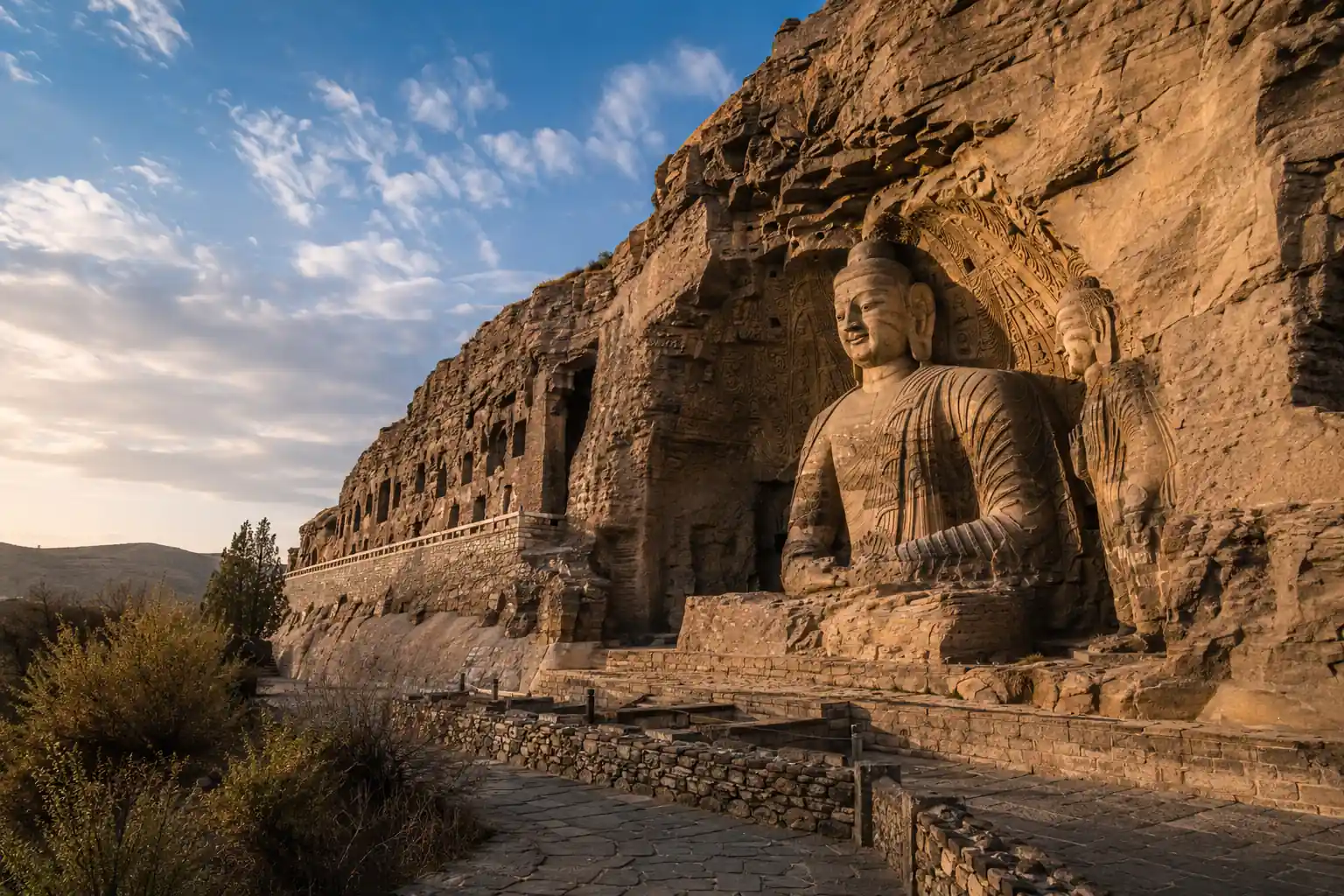
This view shows the sculpted cave facade at Yungang, the city's strongest reason to come and the anchor for any first Datong day.
Suggested routes
Itineraries for Datong
This aerial view shows how Datong's temple compounds sit inside the rebuilt old core, which is why the city is easiest to plan by clusters rather than isolated sights.
Wikimedia Commons
1 day
Yungang plus old city essentials
Best for a fast heritage stop. Give the morning to the grottoes, then finish with the temple-and-wall core in the city.
1Yungang Grottoes in the morning
2Return to the Ancient City for Huayan Temple or Shanhua Temple
3Nine-Dragon Wall and nearby old-core streets in the late afternoon
4City wall walk or night view in the evening
2 days
Classic Datong first visit
Enough time to separate the city core from the long excursion day and keep the pace reasonable.
1Day 1: Huayan Temple, Shanhua Temple, Nine-Dragon Wall, and the Ancient City wall
2Day 2: Yungang Grottoes, then continue to the Hanging Temple if you have prearranged transport and an early start
3Leave dinner flexible in the old city for noodles or other Shanxi dishes
3-4 days
Deeper northern Shanxi base
Use Datong as a heritage base, not just a checklist stop, and give one day to the mountain corridor or a Shanxi continuation.
1Day 1: Ancient City core, Huayan Temple, Shanhua Temple, and the wall
2Day 2: Yungang Grottoes with time to slow down inside the cave clusters
3Day 3: Hanging Temple and, if conditions suit, part of Mount Heng
4Day 4: Continue south toward Pingyao or Taiyuan, or take a road extension toward Yingxian
Neighborhoods
Best Areas to Explore
Ancient City and central temple quarter
This is the practical center for most short stays: a rebuilt walled core anchored by Huayan Temple, Shanhua Temple, the Nine-Dragon Wall, and evening walks on or around the city wall. It is the best area for first-time visitors because you can cover several major sights on foot or with short taxi hops.
Huayan TempleShanhua TempleNine-Dragon Wall
Yungang western outskirts
About 16 km west of central Datong, the Yungang Grottoes are not a casual add-on but a dedicated half-day or longer visit. The site is the city's biggest historical draw, so it is worth building a clean block of time around it instead of squeezing it between urban stops.
Yungang GrottoesCliffside cave carvingsWestern approach from the city
Hunyuan and Mount Heng corridor
Southeast of Datong, this day-trip corridor links the Hanging Temple with Mount Heng, the northern mountain of China's Five Great Mountains. It is best for travelers who want one long scenic day rather than more city temples, and transport planning matters more here than sightseeing density.
Hanging TempleMount HengHunyuan day-trip route
South station and modern Pingcheng
The newer districts around Datong South Railway Station are useful for rail arrivals, wider roads, newer hotels, and straightforward onward departures. Stay here if logistics matter more than atmosphere, especially on a late arrival or before an early high-speed train.
Datong South Railway StationModern hotel optionsEasy road access for day trips
What to see
Top Sights
Yungang Grottoes
These Northern Wei cave temples west of Datong are the city's defining sight and one of China's major Buddhist art sites. The grottoes date mainly from the 5th and 6th centuries, with dozens of major caves and thousands of carved figures spread along the cliff face.
Give this at least half a day and do not schedule a tight city lunch afterward; the site rewards a slower visit.
Hanging Temple
Built into a cliff in Hunyuan County near Mount Heng, the Hanging Temple is one of the most visually distinctive religious sites in north China. Its appeal is not only the dramatic setting but also the way Buddhist, Taoist, and Confucian references meet in one structure.
Combine it with Mount Heng only if you start early and already have transport arranged; otherwise let the temple be the main goal.
Huayan Temple
Huayan Temple in the city center is one of Datong's strongest urban sights, with a long history of destruction and rebuilding but major surviving Liao and Jin era architecture. It works especially well as a counterweight to Yungang because it brings the city's later temple culture back into focus.
Visit it as part of a compact old-city walking block with the wall or Nine-Dragon Wall instead of treating it as a standalone taxi ride.
Shanhua Temple
Shanhua Temple is quieter than Huayan but especially rewarding if you care about surviving 11th- and 12th-century timber architecture. Its older halls and calmer atmosphere make it one of Datong's best places to slow down and look carefully rather than rush for photos.
Use this when you want a less crowded old-city block, especially after the heavier logistics of Yungang or Hunyuan.
Datong Ancient City Wall
The city wall is largely a reconstruction, but it still works well as a planning and orientation tool for visitors in the rebuilt old core. It gives broad views over the city and helps tie together temple visits, gate towers, and the evening atmosphere around the Ancient City.
Treat it as a late-afternoon or evening walk and combine it with the nearby old core rather than making a separate daytime detour.
Getting around
Transport Notes
Arriving by air
Datong Yungang International Airport (DAT) sits about 15.2 km from the city center. It is useful for domestic arrivals and some international links, but for Beijing in particular the high-speed train is often the simpler choice.
Arriving by train
High-speed services use Datong South Railway Station on the Datong-Zhangjiakou and Datong-Xi'an high-speed lines. Beijing, Hohhot, Taiyuan, and Pingyao can all work as sub-2.5-hour rail connections, while conventional trains use Datong Railway Station.
Getting around
City buses are frequent and cheap, and the Ancient City can be explored on foot once you are in the core. The problem is not cost but spread: Yungang, Hunyuan, and Mount Heng are not compact urban stops, so day planning matters more than local transit theory.
Taxis and ride-hailing
Taxis and ride-hailing are the easiest way to move between the old city, Yungang, and the newer rail districts. Save attraction and hotel names in Chinese, especially if you are chaining a long day trip outside the center.
Food
What to Eat
Start with Shanxi noodles
Datong is closely associated with knife-cut noodles (daoxiaomian), one of Shanxi's best-known wheat staples. The noodles are shaved directly from a block of dough into boiling water, which gives them a thick, chewy texture. Also look for simple dumplings (jiaozi) and noodle soups before chasing more elaborate meals.
Use the Ancient City for easy dinners
After Huayan Temple, Shanhua Temple, or a city wall walk, the rebuilt old core is the easiest zone for practical meals. It lets you compare casual Shanxi restaurants, noodle shops, and snack stops without another long transfer. For a short stay, this is more useful than crossing town for one specific restaurant.
Expect hearty northern flavors
Compared with some eastern or southern Chinese cities, Datong menus lean more toward wheat, lamb, soups, and vinegar-led seasoning. Shanxi mature vinegar appears often and helps define the region's flavor profile. In colder weather, local food makes more sense as a warming break between temple and wall visits than as a separate culinary mission.
Go next
Easy Trips from Datong
Hunyuan and Mount Heng
The most natural extension from Datong, pairing the Hanging Temple with time on Mount Heng, usually as a full day by hired car or organized transport.
Yingxian
Best known for its wooden pagoda, Yingxian works as an architecture-focused side trip east of Datong when you want more than temples and grottoes.
Pingyao
A strong southbound continuation for deeper Shanxi heritage, reached from Datong South by the same high-speed corridor that links Datong with Taiyuan and other southern Shanxi cities.
Keep planning
Useful next pages for Datong
Connect this city page with the practical setup decisions most likely to affect arrival, tickets, transport, and daily movement.