Pingyao is one of China's best-preserved walled towns, useful for slow walks, courtyard stays, and understanding Shanxi merchant history.
Suggested stay
1-2 days
Travel style
Ancient Town
Best for
Ancient city walls, old streets, heritage stays
Content confidence
Reviewed for practical travel use
Pingyao city overview, suggested stay, highlights, transport notes, nearby trips, and connected planning guides have been reviewed for practical trip planning.
Use this city page as a planning framework. Confirm current opening hours, ticket windows, transport schedules, and local rules before booking.
Check official sources before booking time-sensitive items.
Planning overview
How to Plan Pingyao
Pingyao works best as a slow heritage stop rather than a checklist city. Come for one or two nights if you want a compact old-town stay, courtyard guesthouses, city-wall walks, and a clearer sense of Shanxi merchant history than you get in larger cities. Plan one day inside the walls and, if time allows, add the outlying temples, because the strongest version of Pingyao is not only the streets but the wider UNESCO ensemble around them.
Pingyao Ancient CityCity WallRishengchang Exchange Shop
Best suited for
Walled-city walks
Courtyard inn stays
Shanxi merchant history
Slow North China routes
Best time to visit
Spring and autumn are the easiest seasons for Pingyao: clear light, cooler walking weather, and enough comfort for long hours on foot. Summer is greener but hotter and rainier, while winter is dry, cold, and sometimes windy, though the low-season atmosphere can suit travelers who care more about architecture than comfort.
Stay inside the ancient city if you want the full courtyard-inn atmosphere, but choose a gate-side property if you are arriving with luggage.
Use Pingyao Gucheng station for most high-speed arrivals, then expect a short bus or taxi transfer into the old city.
Walk the city wall early or late in the day; midday sun is harsher and the ramparts feel more exposed than the lanes below.
Check the current combined-ticket rules before planning museum-heavy days, because several major sights inside the walls are covered by the same pass.
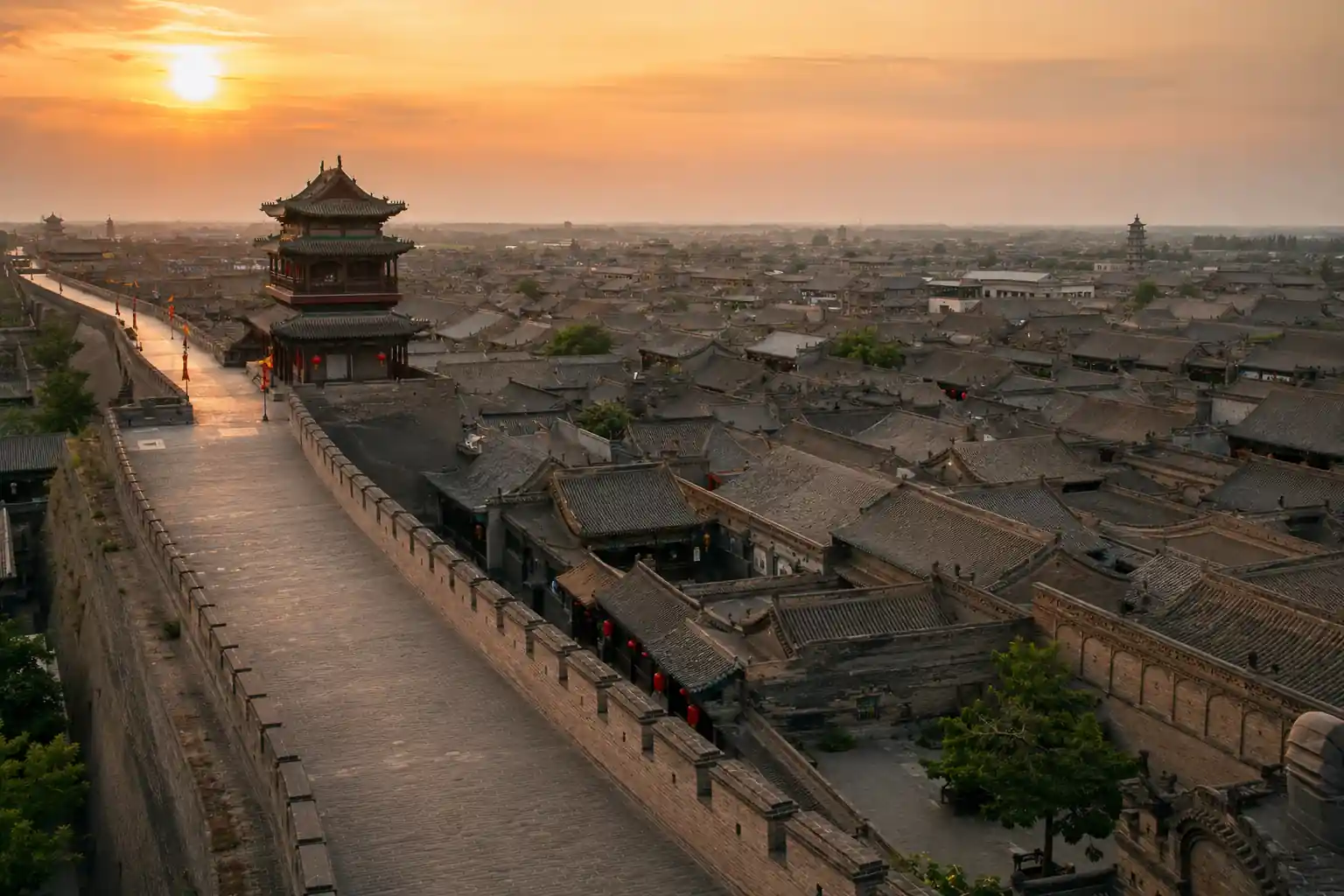
The aerial view shows how intact the walled street grid remains, which helps visitors understand why Pingyao is best explored on foot rather than by isolated monuments.
Suggested routes
Itineraries for Pingyao
The wall matters not just as a photo stop but as the clearest way to read the city plan and defensive layout from above.
Wikimedia Commons
1 day
Ancient city essentials
Best for travelers passing through on a Shanxi rail route. Keep the day inside the walls and save some energy for the evening atmosphere.
1Walk the city wall in the morning before the streets fill up
2Follow South Street and visit Rishengchang before lunch
3Spend the afternoon around the County Yamen and temple quarter
4Stay inside the walls for dinner and a quieter evening lane walk
2 days
Pingyao plus the full UNESCO picture
The best version for most visitors: one day in the old city, one day for the temples beyond it.
1Day 1: City wall, South Street, Rishengchang, County Yamen, City God Temple
2Day 2: Shuanglin Temple and Zhenguo Temple by taxi or arranged car, then return for a final old-town walk
3Use the second evening for a courtyard stay instead of trying to add another distant excursion
3-4 days
Slow Shanxi heritage stop
Use extra time for a slower pace rather than repeating similar courtyards. Pingyao rewards rest, photography, and one onward extension more than constant museum hopping.
1Day 1: Settle inside the old city and do the wall plus the main commercial streets
2Day 2: Focus on Rishengchang, the County Yamen, and the City God or Confucian temple complex
3Day 3: Make the temple circuit to Shuanglin Temple and Zhenguo Temple
4Day 4: Continue to Taiyuan or Xi'an rather than stretching Pingyao itself too thin
Neighborhoods
Best Areas to Explore
South Street and the old commercial spine
This is the most immediately legible part of Pingyao for first-time visitors: banks, shops, courtyard compounds, and the densest flow of visitors. It is the right place to start if you want the merchant-city story before branching into quieter lanes.
South StreetRishengchang Exchange HouseMain market lanes
Temple and government quarter
Pingyao is strongest when you read it as a functioning county seat rather than a film set. Around the yamen, City God Temple, and Confucian Temple, the old administrative and ritual structure of the town becomes clearer.
Pingyao County YamenCity God TempleConfucian Temple
Wall edge and gate circuit
The perimeter is where Pingyao becomes calmer. Walking near the gates and then climbing the ramparts helps you understand the tortoise-shaped layout, the moat line, and how compact the old city really is.
North and south gatesCity wall walkMoat views
Outlying temple countryside
The wider Pingyao UNESCO site extends beyond the walls. Shuanglin Temple and Zhenguo Temple add the deeper Buddhist art and early architecture that the old city itself cannot cover on its own.
The wall is the clearest single introduction to Pingyao because it turns the old city from a collection of lanes into a readable plan. The current brick-and-stone line dates from 1370, runs about 6 km, and still carries watchtowers, gates, and the broad outline of the old defenses.
Walk at least one substantial section instead of only climbing for photos, and choose morning or late afternoon for softer light.
Rishengchang Exchange House
Rishengchang is the most useful stop for understanding why Pingyao mattered far beyond Shanxi. Opened in 1823 as the first piaohao, it turned the city into the center of a national remittance and draft-banking network during the Qing period.
Visit early in your stay, because the banking history gives context to many other courtyard compounds around South Street.
Pingyao County Yamen
The yamen is one of the best-preserved county government compounds in China and helps ground the old city in real administration rather than nostalgia. The complex includes formal gates, offices, court space, a prison, residential quarters, and garden areas tied to the magistrate's work.
Pair it with the nearby temple quarter so the administrative and ritual sides of the old county seat make sense together.
Shuanglin Temple
About 6-7 km southwest of the ancient city, Shuanglin Temple is the strongest outlying sight if you care about Buddhist art. It was founded in the 6th century and is especially known for its large group of painted clay sculptures from later dynasties.
Do not treat it as an afterthought; it deserves dedicated time because the sculpture halls add something the old-town courtyards do not.
Zhenguo Temple
Zhenguo Temple lies about 10 km outside Pingyao and is best known for the Wanfo Hall, built in 963 during the Northern Han. It is one of the rare places near Pingyao where early timber architecture and 10th-century Buddhist sculpture become the main reason to go.
Combine it with Shuanglin Temple in the same half-day or full-day outing; the value is in seeing the outlying ensemble together.
Getting around
Transport Notes
Arriving by air
Pingyao has no commercial airport of its own, so most visitors arrive via Taiyuan Wusu International Airport and continue overland. Taiyuan is roughly 90 km away, making it the practical air gateway if you are combining Pingyao with Taiyuan or wider Shanxi travel.
Arriving by train
For most travelers, the easiest arrival is by high-speed train to Pingyao Gucheng station, followed by a short transfer into the ancient city. Taiyuan is about 45 minutes away by fast train, and Xi'an is also practical by D- or G-series services, which makes Pingyao easy to insert into a north China rail route.
Getting around
Inside the walled city, walking is the default because the lanes are compact and many of the most useful sights sit close together. You only really need a vehicle for station transfers or for outlying sites such as Shuanglin Temple and Zhenguo Temple.
Taxis and ride-hailing
Taxis are most useful between the railway station area, the old-city gates, and the temple sites outside town. Ride-hailing can help at the edges of Pingyao, but inside the ancient city you should expect to be dropped near a gate and walk the last section to your guesthouse.
Food
What to Eat
Pingyao beef and cold dishes
Pingyao is best known for Pingyao beef, usually served sliced and often paired with straightforward cold dishes rather than elaborate banquet-style cooking. It is a useful first meal in the old town because it is easy to find, local to the area, and lighter than some heavier Shanxi staples.
Shanxi noodles over novelty snacks
If you want a more substantial meal, look for Shanxi noodle dishes rather than relying only on street snacks in the busiest visitor lanes. Pingyao can feel touristy around the main commercial streets, so a simple noodle shop slightly off the central spine is often a better use of your time than chasing themed old-town snacks.
Courtyard dinners and practical expectations
Eating inside the walls is more about atmosphere than culinary range, and many travelers end up choosing a courtyard restaurant for convenience after dark. That works well enough for one evening, but expectations should stay practical: Pingyao is stronger for heritage ambiance than for destination dining.
Go next
Easy Trips from Pingyao
Taiyuan
Taiyuan is the natural transport hub before or after Pingyao, and it works well if you need airport access, a bigger city base, or a broader Shanxi route. Most travelers use it as a half-day or overnight link rather than trying to see everything in one rush.
Jiexiu and Mianshan
Jiexiu is the rail stop usually associated with onward visits to Mianshan, a scenic mountain-and-temple area southwest of Pingyao. It makes more sense as a separate day or next stop than as a quick add-on to a one-night Pingyao stay.
Qixian and the Qiao Family Compound
Qixian is another common heritage extension in central Shanxi, best known to many visitors for the Qiao Family Compound. If you are interested in merchant-era courtyard architecture beyond Pingyao itself, this is one of the more logical follow-up stops.
Keep planning
Useful next pages for Pingyao
Connect this city page with the practical setup decisions most likely to affect arrival, tickets, transport, and daily movement.