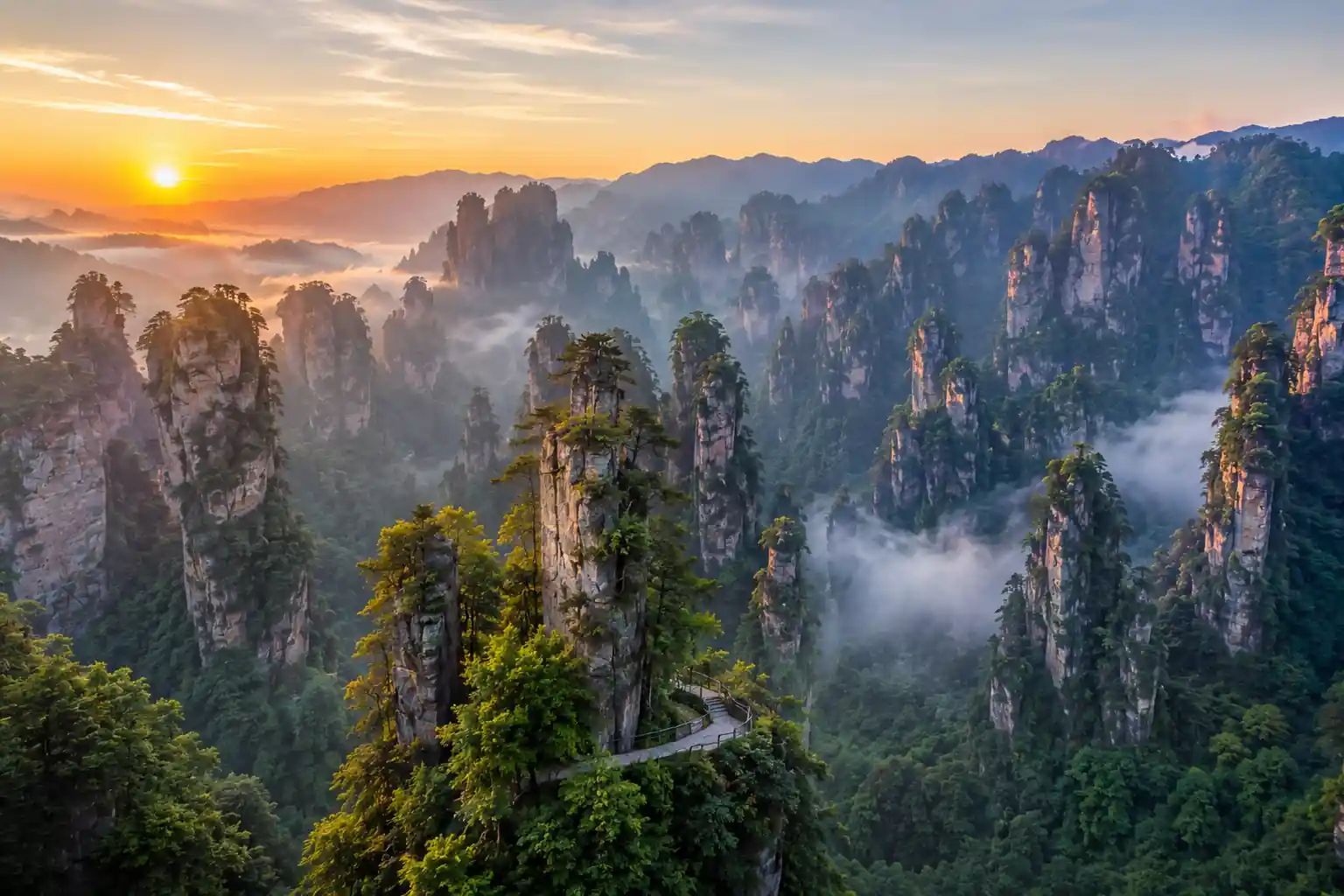
Zhangjiajie is a nature-heavy trip built around national forest park routes, glass bridges, mountain cableways, and weather-dependent views.
Suggested stay
2-4 days
Travel style
Nature
Best for
Mountains, photography, outdoor scenery
Content confidence
Reviewed for practical travel use
Zhangjiajie city overview, suggested stay, highlights, transport notes, nearby trips, and connected planning guides have been reviewed for practical trip planning.
Use this city page as a planning framework. Confirm current opening hours, ticket windows, transport schedules, and local rules before booking.
Check official sources before booking time-sensitive items.
Planning overview
How to Plan Zhangjiajie
Zhangjiajie works best as a landscape trip, not a city break. Most travelers come for the Wulingyuan pillar scenery, Tianmen Mountain, and a few high-profile engineering attractions, then use Yongding or Wulingyuan as their practical base. Plan around weather, early starts, and transfers between scenic zones rather than around urban sightseeing. With two to four days, you can combine one urban-side mountain, one or two full park days, and a slower cave or glass-bridge day without turning the trip into a rush.
National Forest ParkTianmen MountainGlass Bridge
Best suited for
Mountain scenery and photography
Cable cars and cliff walks
2-4 day nature-focused trips
Travelers comfortable with early starts
Best time to visit
Spring and autumn are the easiest seasons, especially April-May and September-October, when temperatures are workable and the pillar scenery often looks good under mist or clearing weather. Summer is lush but hot, humid, and rain-prone, while winter can be atmospheric with fog or occasional snow and fewer crowds, though walkways may be slippery and visibility is less predictable.
Choose your base carefully: Yongding is better for the airport, rail stations, and Tianmen Mountain, while Wulingyuan is better for multi-day park access.
Do not treat Zhangjiajie National Forest Park and Tianmen Mountain as one easy same-day checklist unless you are comfortable with a long, logistics-heavy day.
Start early for the big scenic areas, and remember the budget bus link from Zhangjiajie city to Wulingyuan or the park usually begins around 06:30 and winds down in the early evening.
Carry layers and decent shoes even in warm months: the scenic core can be cooler, wetter, and more slippery than the city.
The trip is built around the pillar landscape, because it determines where you stay and how you pace each day.
Suggested routes
Itineraries for Zhangjiajie
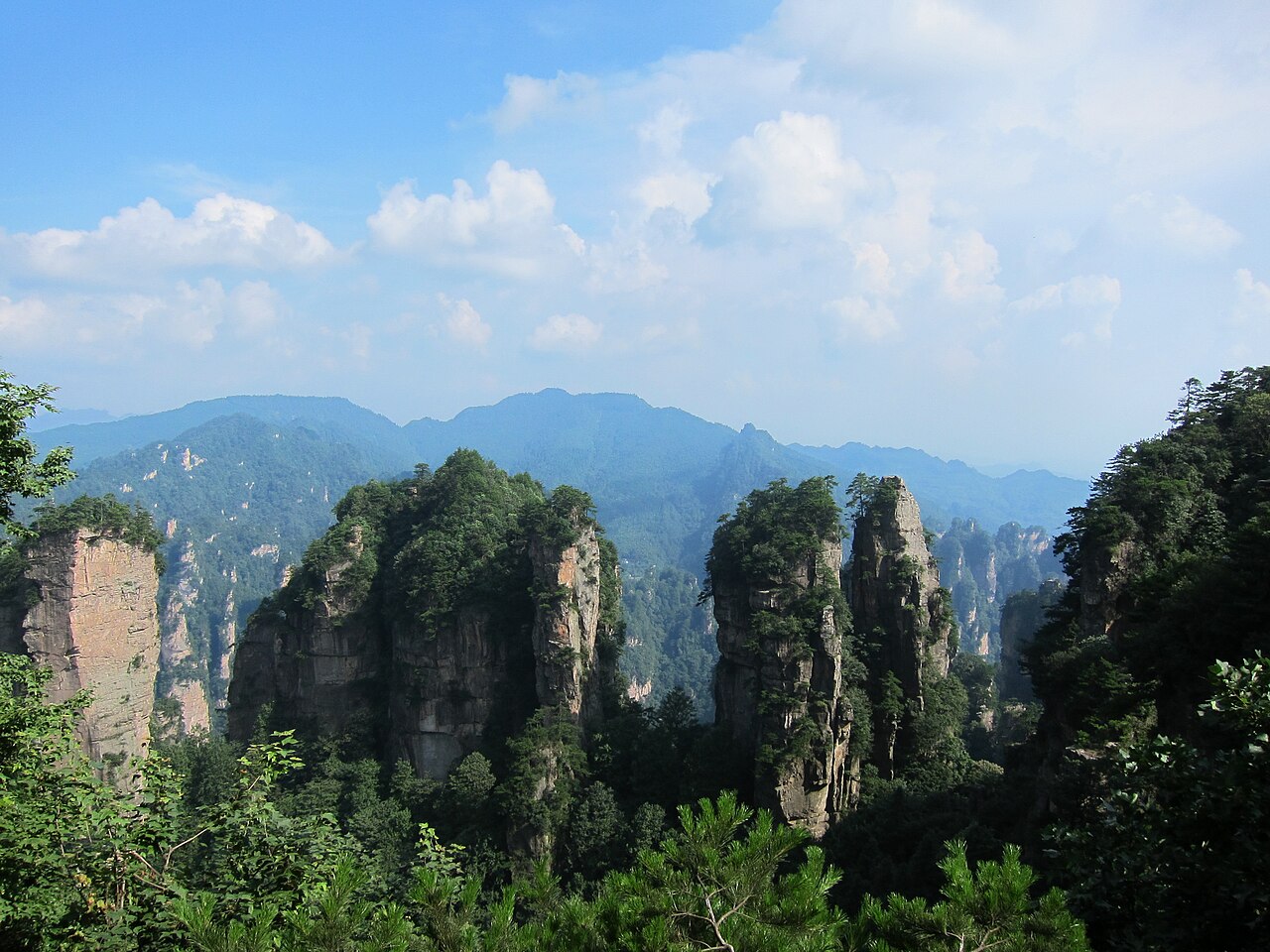
Tianmen Mountain matters because it gives Zhangjiajie a different kind of day: closer to the city, but still weather-dependent and full of vertical movement.
Wikimedia Commons
1 day
One big landscape day
Best for a tight schedule. Pick one major mountain system and do it properly instead of rushing between both sides of the city.
1Option A: Tianmen Mountain by cableway and cliff walks
2Option B: Wulingyuan park core with one ascent route and one descent route
3Keep lunch inside the chosen zone rather than transferring midday
4Use the evening for a simple meal near your hotel, not another attraction
2 days
The first-timer split
Enough time to see why Zhangjiajie is famous without forcing every add-on into the same trip.
1Day 1: Tianmen Mountain from Yongding, then overnight in Yongding or transfer to Wulingyuan
2Day 2: Zhangjiajie National Forest Park with Yuanjiajie, Tianzi Mountain, or Golden Whip Stream
3Use the second night near Wulingyuan if you plan to continue deeper into the park
3-4 days
Full Zhangjiajie without overloading
This is the most comfortable version of the trip, giving the park time to breathe and leaving room for weather changes.
1Day 1: Arrive in Yongding, do Tianmen Mountain if time and weather allow
2Day 2: Wulingyuan core with Yuanjiajie, Bailong Elevator, and Tianzi Mountain
3Day 3: A slower park route such as Huangshizhai or Golden Whip Stream, or switch to Baofeng Lake or Huanglong Cave
4Day 4: Zhangjiajie Glass Bridge or a nearby rail side trip such as Furong Town or Fenghuang
Neighborhoods
Best Areas to Explore
Yongding and the Tianmen Mountain base
This is the practical arrival zone around the airport, the rail and bus stations, and the Tianmen Mountain Cableway. Stay here if you land late, leave early, or want to do Tianmen Mountain first without shifting hotels immediately.
Tianmen Mountain CablewayZhangjiajie railway station areaCentral bus station
Wulingyuan town and the park entrances
Wulingyuan is the best base for the classic Zhangjiajie trip. Hotels, ticketing, buses, and park access are simpler here, and evenings are quieter than in Yongding. If you plan two or more days inside the scenic area, this is usually the most efficient place to sleep.
Wulingyuan townEast gate accessPark shuttle and hotel cluster
The national forest park core
This is where the big pillar scenery, elevators, cable cars, and long walking routes live. Treat it as a full terrain system rather than a single attraction, and choose one circuit at a time instead of trying to clear the entire map in one push.
YuanjiajieTianzi MountainGolden Whip Stream
Grand Canyon and cave side trips
Outside the core pillar routes, this is the easiest third-day add-on zone for the Glass Bridge, Huanglong Cave, and Baofeng Lake. It works well when you want a different rhythm from another full day of buses, steps, and summit viewpoints.
Zhangjiajie Glass BridgeHuanglong CaveBaofeng Lake
What to see
Top Sights
Zhangjiajie National Forest Park
This was recognized in 1982 as China's first national forest park and remains the core image most travelers associate with Zhangjiajie. The pillar formations sit inside a much larger Wulingyuan system, so the main challenge is not whether to go but how to choose a manageable route through it.
Start from the gate closest to your hotel and use cable cars or the Bailong Elevator strategically instead of trying to hike every ascent and descent.
Tianmen Mountain
Tianmen Mountain gives Zhangjiajie a different kind of day from Wulingyuan: a dramatic natural arch, cliffside walkways, and a cableway that runs from near the older Zhangjiajie railway station up into the mountain park. It is closer to the city than the forest park but still deserves most of a day.
Use the clearest day of your stay here if possible, because fog can remove the long views that make the cliffs and cableway most rewarding.
Tianzi Mountain and Yuanjiajie
This is one of the strongest scenic combinations inside Wulingyuan: broad viewpoints over the sandstone pillars, the famous pillar-and-ravine terrain, and the vertical shortcut of the Bailong Elevator. It is the part of Zhangjiajie that most clearly explains the park's scale and verticality.
Pair one mechanical lift with one walking section so the day feels balanced rather than like a nonstop queue-to-queue transit exercise.
Zhangjiajie Glass Bridge
The bridge in the Grand Canyon opened in 2016 and stretches 430 m across the canyon, suspended roughly 300 m above the ground. It is a separate excursion from the pillar park rather than an add-on viewpoint, and it appeals most to travelers who enjoy engineered attractions as much as natural scenery.
Treat it as its own timed excursion and avoid squeezing it into the back half of a full Wulingyuan day.
Huanglong Cave
Huanglong Cave offers a different texture from the exposed peaks above ground: a large karst cave system with dry and wet levels, underground rivers, and a guided route that includes a boat ride. It is one of the most useful alternatives when you want a scenic day that is less dependent on summit visibility.
Keep this for a wet, hot, or lower-energy day, especially if you have already done one or two demanding park circuits.
Getting around
Transport Notes
Arriving by air
Zhangjiajie Hehua International Airport is the city's main air gateway. It sits about 5 km from downtown Yongding and about 30 km from Wulingyuan, so air arrivals still need to think about which side of Zhangjiajie they want to sleep on first.
Arriving by train
Zhangjiajie West is the key high-speed rail station, opened in 2019 and connected to the Qianjiang-Changde line and the Zhangjiajie-Jishou-Huaihua high-speed line. The older Zhangjiajie railway station remains useful around the Tianmen Mountain side of town.
Getting around
For city-to-park movement, buses from the central bus station are the budget default, with routes toward Wulingyuan and the national forest park and travel times of roughly 45-60 minutes. Inside the scenic areas, shuttle buses, cable cars, the Bailong Elevator, and a lot of walking do the real work.
Taxis and ride-hailing
Taxis and ride-hailing are most useful with luggage, early departures, or when shifting between Yongding and Wulingyuan. Save the Chinese name of your hotel and entrance, because "Zhangjiajie" can mean the city, the park, or the broader scenic area.
Food
What to Eat
Expect western Hunan flavors
Zhangjiajie sits in western Hunan, so food often leans dry-spicy, smoky, and sour rather than sweet or numbing. Look for Xiangxi-style cured meats, pickled vegetables, fresh chopped chiles, rice tofu, and straightforward stir-fries built around mountain vegetables. If you are sensitive to heat, ask for less chili early because many kitchens assume visitors came ready for Hunan levels.
Eat close to your base
In Yongding, meals are easiest around the rail and bus core and near the Tianmen Mountain side of town, where you can fit dinner around arrival or departure. In Wulingyuan, keep dinner near your hotel because park days start early and end tired. Food inside scenic areas is mainly about convenience, so the stronger meal is often before entering or after returning.
Use Xiangxi and Tujia dishes as anchors
Menus vary, but regional cues are useful: smoked or cured pork, sour meat, rice tofu, local fish, and hotpot-style dishes appear across the broader Xiangxi and western Hunan region. Do not build the trip around one famous restaurant. This is a place where a simple local dining room can be more rewarding than a scenic-area tourist menu.
Go next
Easy Trips from Zhangjiajie
Furong Town
An easy extension on the Zhangjiajie-Jishou-Huaihua high-speed line, usually done as a long day or overnight for waterfall-backed old-town scenery.
Fenghuang Ancient Town
Longer than Furong but still practical by high-speed rail to Fenghuang Gucheng, then the local maglev into the scenic area; better as an overnight than a rushed day.
Changsha
A sensible contrast after the mountains, reached by rail when you want to switch from scenic logistics to museums, street food, and a larger Hunan city.
Keep planning
Useful next pages for Zhangjiajie
Connect this city page with the practical setup decisions most likely to affect arrival, tickets, transport, and daily movement.