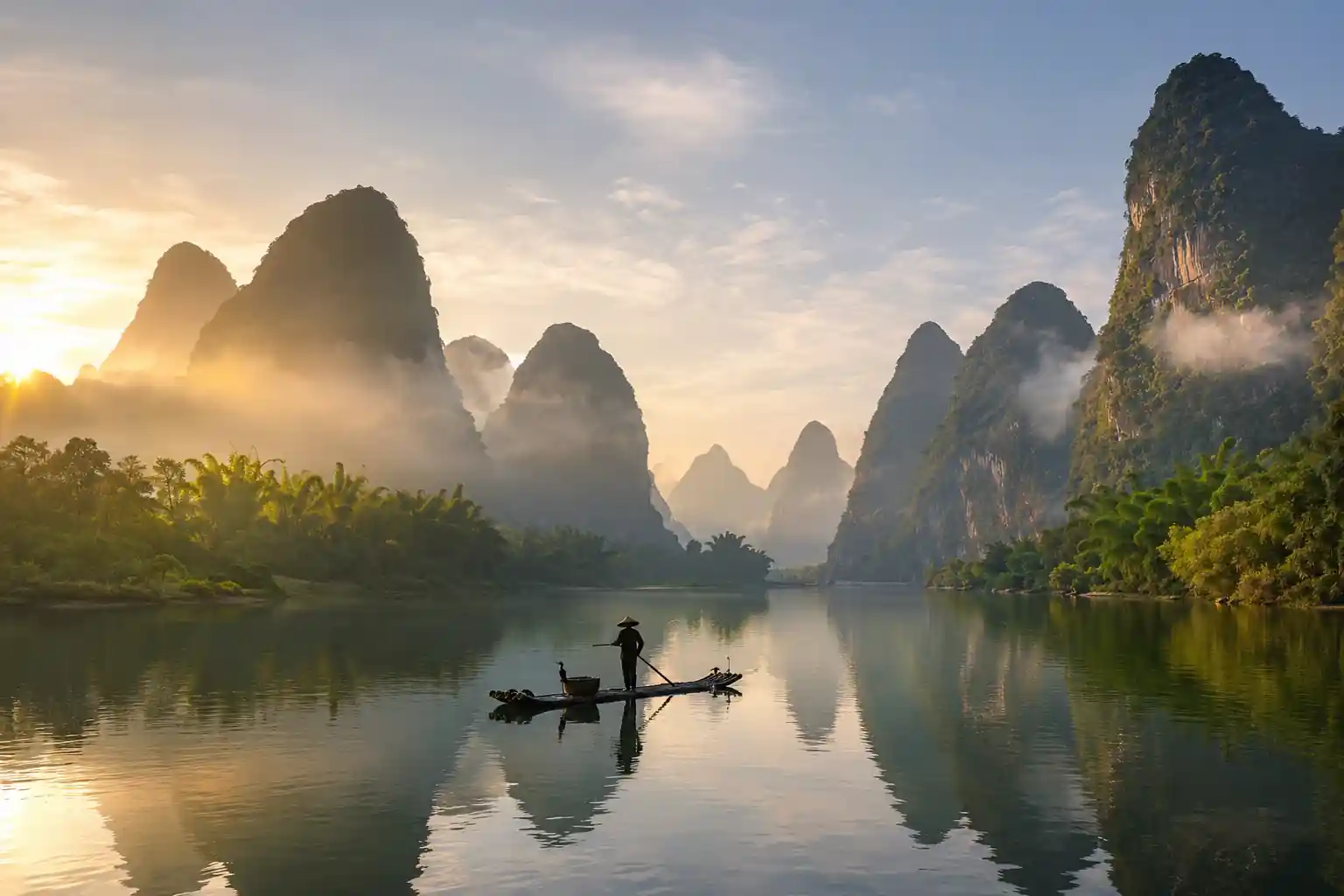
Guilin and nearby Yangshuo are best for landscape-focused trips, with river routes, karst peaks, rice terraces, and slower countryside pacing.
Suggested stay
2-4 days
Travel style
Nature
Best for
Landscape photography, rivers, outdoor scenery
Content confidence
Reviewed for practical travel use
Guilin city overview, suggested stay, highlights, transport notes, nearby trips, and connected planning guides have been reviewed for practical trip planning.
Use this city page as a planning framework. Confirm current opening hours, ticket windows, transport schedules, and local rules before booking.
Check official sources before booking time-sensitive items.
Planning overview
How to Plan Guilin
Guilin works best as a landscape base rather than a dense city-break destination. Come for karst hills, river scenery, short cave and hill visits in town, then use the city to connect to Yangshuo, Xingping, or the Longji rice terraces. For most travelers, the strongest plan is one night in Guilin for the urban sights and logistics, then one or two slower nights closer to the countryside.
Li RiverYangshuoLongji Rice Terraces
Best suited for
Karst landscape photography
River and countryside routes
Slower South China pacing
2-4 day nature-focused trips
Best time to visit
Autumn is usually the easiest season for Guilin: drier skies, clearer views, and better conditions for river and hill scenery. Spring is lush but often wet and overcast, while April to June is the rainiest period and can bring flooding or low visibility. Summer is hot and humid, and winter is cool, quieter, and still workable if you mainly want city sights plus a chance of misty river scenery.
Do not treat Guilin city and Yangshuo as the same stop: many good 2-4 day trips split time between both.
Keep Li River cruises, hill viewpoints, and rice terrace days flexible because rain, fog, and river visibility change the experience.
Stay near the central lakes, Zhengyang pedestrian area, or Guilin Railway Station for the easiest first-night logistics.
Book or reconfirm river cruise, terrace transport, and holiday-period tickets before committing your full route around them.
Start with the landscape logic: Guilin is easiest to plan when you treat the city as the gateway to the surrounding karst region.
Suggested routes
Itineraries for Guilin
The Li River corridor is why many travelers come to Guilin in the first place, and it helps decide whether you should add Yangshuo or Xingping.
Wikimedia Commons
1 day
City highlights without rushing
Best for an arrival day or short stop when you want Guilin itself rather than a full countryside transfer.
1Jingjiang Princes' City and Solitary Beauty Peak in the morning
2Elephant Trunk Hill and the south riverside in the afternoon
3Shan Lake, Rong Lake, and the Sun and Moon Pagodas after dark
4Optional Zhengyang area dinner if you want one easy central evening
2 days
Guilin plus the classic river route
This is the standard first-timer split: one urban day and one landscape day.
1Day 1: Elephant Trunk Hill, Jingjiang Princes' City, central lakes, and an evening walk
2Day 2: Li River route toward Yangshuo, then decide whether to overnight in Yangshuo or return late
3If weather is poor, swap the river day for Reed Flute Cave plus Seven Star Park
3-4 days
City, river, and countryside depth
Use the extra time to avoid cramming the region into one long day and to add a second landscape base.
1Day 1: Central Guilin, Elephant Trunk Hill, and the lakes district
2Day 2: Li River route to Yangshuo and an overnight there if possible
3Day 3: Yangshuo countryside, Yulong River area, or Xingping viewpoints
4Day 4: Longji rice terraces or a return to Guilin for Reed Flute Cave and a slower departure
Neighborhoods
Best Areas to Explore
Central Guilin and the Two Rivers Four Lakes area
This is the most practical first-time base: central hotels, pedestrian streets, lake walks, and straightforward access to stations and day-trip pickups. Guilin is not a giant urban sightseeing city, so being central matters more than chasing a fashionable neighborhood.
Shan Lake and Rong LakeZhengyang Pedestrian StreetEvening riverside walks
Jingjiang Princes' City and Xiufeng core
This part of Guilin brings together the city's older political history, one of its best-known historic compounds, and a more grounded local-student feel because the palace area now overlaps with Guangxi Normal University. It works well for a half day when you want culture and views without leaving town.
The south side of central Guilin gives you the city's signature karst landmark plus easy river views and a simple sightseeing loop back toward the lakes. It is one of the easiest zones to use on an arrival day or before a train.
Elephant Trunk HillLi River embankmentSun and Moon Pagodas
East bank parks and city karst hills
This side of Guilin is useful when you want more space, greenery, and the city's classic mix of parkland, cave visits, and steep limestone outcrops. It is less about nightlife and more about pacing your sightseeing outdoors.
Seven Star ParkFubo HillDiecai Hill
What to see
Top Sights
Li River route to Yangshuo
The Li River between Guilin and Yangshuo is the region's defining landscape: clear water, limestone peaks, and the scenery most visitors associate with Guangxi. It is less a single city attraction than the main reason to build a Guilin trip around weather and pacing.
Choose a clear or lightly misty day if possible, and decide early whether you want a through-route into Yangshuo or a same-day return.
Elephant Trunk Hill
This limestone hill at the meeting area of city and river is Guilin's best-known landmark. Its importance is practical as well as symbolic: it gives first-time visitors an easy, central encounter with the karst shapes that define the whole region.
Use it as part of a central walking loop rather than a long standalone visit, especially on busy weekends or holidays.
Reed Flute Cave
Reed Flute Cave is Guilin's best-known cave visit, with large chambers, colored lighting, and a straightforward half-day format. It is especially useful when you want karst geology without committing to a full day outside the city.
This is one of the better bad-weather options in Guilin, and it combines more naturally with a hill or lake walk than with a full river transfer.
Jingjiang Princes' City and Solitary Beauty Peak
This Ming-era princely compound gives Guilin more historical weight than many travelers expect. The palace grounds and peak viewpoint work well together, especially if you want one stop that balances culture, architecture, and a city panorama.
Go earlier in the day if you want a calmer visit and better light for the uphill viewpoint.
Seven Star Park
Seven Star Park is one of the city's broadest green areas, combining karst hills, caves, and longer walking space than the compact central landmarks. It is useful when you want a slower outdoor block without immediately leaving Guilin for the countryside.
Leave more time than you expect, especially in warm weather, because the park is better as a gradual walk than as a quick photo stop.
Getting around
Transport Notes
Arriving by air
Guilin Liangjiang International Airport is the city's main air gateway. Because it sits outside the center, most travelers continue by airport bus, taxi, or ride-hailing either into central Guilin or directly onward toward Yangshuo.
Arriving by train
Guilin is well connected by rail, with Guilin Railway Station most convenient for central stays and Guilin North or Guilin West handling many high-speed services. If you are building a broader Guangxi or south China route, train access is usually easier than flying between nearby cities.
Getting around
There is no metro network to structure your sightseeing, so Guilin works through a mix of walking, city buses, and short taxi hops. Central lakes, palace-area sights, and some riverside routes are walkable together, but the city's cave and park stops are better treated as separate segments.
Taxis and ride-hailing
Taxis and ride-hailing are useful for linking stations, parks, and cave sights without losing time. Save hotel names, stations, and key attractions in Chinese, especially if you are transferring onward to Yangshuo or a river-cruise departure point.
Food
What to Eat
Start with Guilin rice noodles
Guilin rice noodles (mifen) are the city's basic food stop rather than a novelty dish, so it makes sense to try them early and more than once. The usual bowl comes with rice noodles, sliced meat, peanuts, pickled vegetables, and chili sauce, and different shops vary in broth style and toppings. Guilin chili sauce is a local signature and part of the city's food identity, so use it if you want the sharper, more local profile.
Use the region, not just the city
A good Guilin food trip often stretches beyond the city center. Northern Guangxi cooking is known for stronger chili, sour notes, and noodle culture, and common dishes in the wider Guilin-Yangshuo area include beer fish (pijiu yu), stuffed river snails, and dishes using Lipu taro. If you are staying more than one night, it is worth letting the regional route shape what you eat.
Keep meals central and flexible
For simple planning, central Guilin around the lakes and pedestrian streets gives you the easiest concentration of noodle shops, casual local meals, and evening snacks. If you continue to Yangshuo, add one meal there instead of trying to do all your food exploring in Guilin itself. This city is better for steady, practical eating than for building a trip around destination restaurants.
Go next
Easy Trips from Guilin
Yangshuo
The obvious extension from Guilin: a smaller base downstream on the Li River, better for countryside scenery, cycling routes, and a slower overnight than a rushed day trip.
Longsheng and the Longji Rice Terraces
Best when you want mountain scenery and terrace views rather than river karst; most visitors reach it by road from Guilin and choose either a long day or an overnight.
Xingping
A smaller Li River stop known for the classic river-and-karst scene linked to the back of the 20 yuan note, useful for photographers and slower countryside pacing.
Keep planning
Useful next pages for Guilin
Connect this city page with the practical setup decisions most likely to affect arrival, tickets, transport, and daily movement.