Macau pairs colonial-era architecture, Cantonese-Portuguese food, temples, museums, and resort districts in a compact walkable destination.
Suggested stay
1-2 days
Travel style
Heritage
Best for
Food, architecture, Greater Bay Area trips
Content confidence
Reviewed for practical travel use
Macau city overview, suggested stay, highlights, transport notes, nearby trips, and connected planning guides have been reviewed for practical trip planning.
Use this city page as a planning framework. Confirm current opening hours, ticket windows, transport schedules, and local rules before booking.
Check official sources before booking time-sensitive items.
Planning overview
How to Plan Macau
Macau works well as a compact 1-2 day stop when you want heritage streets, temple visits, Portuguese-influenced food, and a very different urban texture from nearby mainland cities. It is small enough to plan by zones rather than by long commutes: keep one day for the historic peninsula, then use the second for Taipa, Cotai, or quieter Coloane. Travelers who only see casinos usually miss the part of Macau that is most distinctive.
Ruins of St. Paul'sSenado SquareTaipa Village
Best suited for
Heritage walks and architecture
Short Greater Bay Area breaks
Macanese and Portuguese-influenced food
Easy 1-2 day city planning
Best time to visit
Autumn is the easiest season for long walking days, with lower humidity and clearer conditions than midsummer. Spring is workable but often damper, while summer is hot, wet, and typhoon-prone. Winter is usually mild rather than severe, so it still suits museums, heritage areas, and food-focused trips.
Stay on the Macau Peninsula for heritage walks, or in Taipa/Cotai if you want newer hotels and easier airport access.
Walk the core heritage zone, but use buses or short taxi rides for jumps between the peninsula, Taipa, Cotai, and Coloane.
Do major outdoor walks earlier or later in the day, especially from late spring to early autumn when heat and humidity build quickly.
Treat the LRT as a useful supplement around Taipa, Cotai, the airport, ferry terminal, and Barra, not as the only transport plan for the whole city.
Macau is easiest to understand as a compact mix of old peninsula streets, water crossings, and newer Taipa-Cotai districts.
Suggested routes
Itineraries for Macau
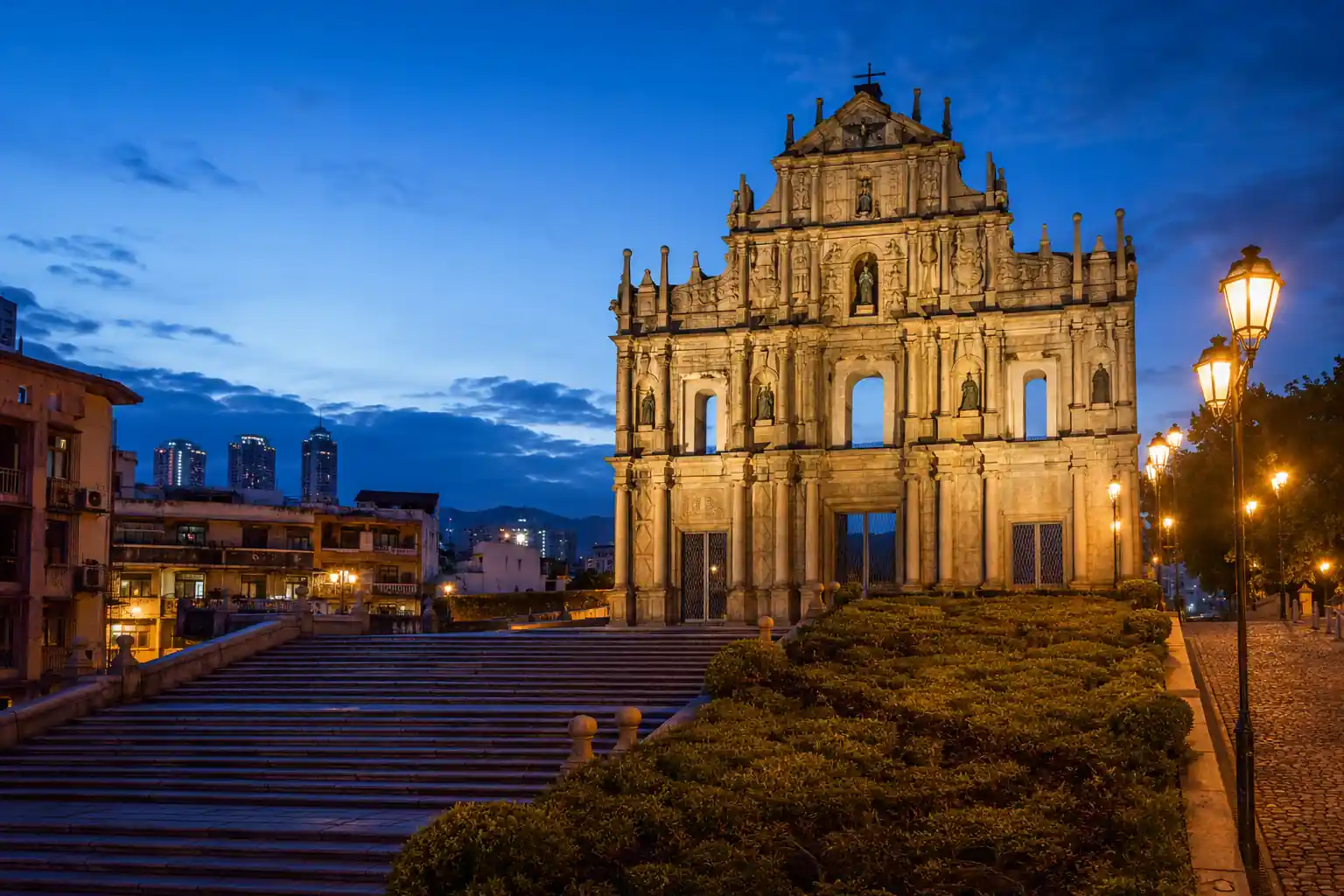
The Ruins of St. Paul are the clearest symbol of Macau's layered Portuguese and Chinese history, so most first itineraries start here or nearby.
Wikimedia Commons
1 day
Historic Macau first pass
Best for a day trip or ferry stop when you want heritage, street atmosphere, and food without spending time on resort hopping.
1Start at Senado Square and the surrounding heritage lanes
2Climb to the Ruins of St. Paul and Mount Fortress before midday crowds build
3Continue south to A-Ma Temple or the Barra side in the afternoon
4Finish with dinner or snacks in Taipa Village if energy allows
2 days
Peninsula plus Taipa balance
This is the most useful first-timer split: one day for heritage density, one day for food, village streets, and modern Macau.
1Day 1: Senado Square, Ruins of St. Paul, Mount Fortress, St. Dominic's, and the Barra side
2Day 2: Taipa Village, Taipa Houses-Museum, Cotai, and either an evening viewpoint or a show
3Add Coloane if you want beaches, village atmosphere, or a slower final half-day
3-4 days
Deeper Macau with nearby extension
Use extra time to slow the pace rather than force more landmarks into one small city.
1Day 1: Historic center on foot with the main UNESCO-area sights
2Day 2: A-Ma Temple, museum time, and an evening around Cotai or Macau Tower
3Day 3: Taipa Village and southern Coloane with food stops and slower walking
4Day 4: Take a nearby trip to Zhuhai, Hengqin, or Hong Kong instead of repeating resort districts
Neighborhoods
Best Areas to Explore
Historic center on the Macau Peninsula
This is the strongest first-time base for Macau: Senado Square, the Ruins of St. Paul, Mount Fortress, churches, civic buildings, and dense side streets all fit into one practical walking zone. It is busy, but the concentration of heritage sights means you can cover a lot without complicated transport.
Senado SquareRuins of St. PaulMount Fortress
Barra and the Inner Harbour side
Southwestern peninsula Macau feels older and more local, with A-Ma Temple, maritime history, and a less polished but more atmospheric edge than the postcard core. Use it when you want a Chinese temple stop and a sense of the city before the Cotai era.
A-Ma TempleBarra districtInner Harbour viewpoints
Taipa Village
Taipa is the easiest second-half district for many visitors: lower-rise streets, food lanes, preserved Portuguese-style houses, and a calmer pace than the peninsula core. It works especially well for a late afternoon food walk before dinner.
Taipa Houses-MuseumTaipa Village lanesRua do Cunha snacks
Cotai and southern Coloane
Cotai is the modern resort strip between Taipa and Coloane, while southern Coloane still offers village streets, beaches, and greener slopes. They make sense together because most visitors pass through Cotai, then choose whether to stay in the resort zone or continue south for something quieter.
Cotai resort stripColoane VillageHac Sa and Cheoc Van area
What to see
Top Sights
Ruins of St. Paul and Mount Fortress
The stone facade of the former Church of Mater Dei is Macau's best-known landmark and one of the clearest reminders of its early Portuguese Catholic history. Pair it with Mount Fortress above, because the two visits together add both context and a wider city view.
Go earlier in the day if possible, then keep walking downhill through the heritage streets instead of treating the facade as a standalone photo stop.
Senado Square
Senado Square is the civic and pedestrian heart of old Macau, framed by wave-pattern paving, colonial-era facades, churches, and side streets that lead naturally toward other major sights. It is less a single monument than the hinge that makes the whole historic center easy to navigate.
Use it as an orientation point, then branch out to nearby churches, alleys, bakeries, and the uphill route toward St. Paul.
A-Ma Temple
A-Ma Temple is one of Macau's oldest and most important Chinese religious sites, sitting near the harbor where the city's older maritime story is easiest to feel. It gives a useful counterweight to the churches and government buildings in the UNESCO core.
Combine it with Barra and the Inner Harbour side rather than squeezing it into the same dense hour as Senado Square and St. Paul.
Taipa Village and Taipa Houses-Museum
Taipa offers one of Macau's easiest neighborhood walks, mixing preserved Portuguese-style houses with snack streets, residential lanes, and a softer pace than the peninsula core. It is a good place to spend time rather than rush through checklists.
Come hungry and late enough for food, but early enough to see the houses and lanes before evening crowds thicken.
Macau Tower
Macau Tower is the clearest modern-city counterpoint to the heritage center, useful for panoramic views, a more contemporary skyline reading, and adventure activities if that matters to your trip. It is not essential for every first visit, but it works well when weather is clear and you want a wider sense of the peninsula, bridges, and Taipa-Cotai side.
Choose it on a clear day or evening; in poor visibility, the heritage core usually gives better value than paying for height.
Getting around
Transport Notes
Arriving by air
Macau International Airport is on Taipa and is most useful for regional flights within Asia. It connects onward by bus, taxi, and the LRT airport station, so Taipa, Cotai, and ferry-terminal areas are straightforward on arrival.
Arriving by train
Macau has no conventional intercity railway station of its own. Most rail arrivals come via Zhuhai, especially the station at the Gongbei border crossing, then continue into Macau on foot, by bus, or by taxi after immigration.
Getting around
The historic peninsula is best explored on foot, while buses do most of the practical work between districts. The LRT is helpful around Taipa, Cotai, the airport, ferry terminal, and now Barra, but it still does not replace buses for every route.
Taxis and ride-hailing
Taxis are useful for late nights, luggage, or direct jumps that would take multiple buses. App-based options are less central to visitor movement than in many mainland cities, so keep hotel and sight names ready and expect queues around peak casino and ferry periods.
Food
What to Eat
Start with Macanese cooking, not only snacks
Macanese cuisine is one of Macau's most distinctive reasons to visit, mixing Portuguese and Chinese influences into a long-standing fusion tradition. Look for minchi, African chicken, bacalhau preparations, and other dishes that feel different from standard Cantonese menus. If you only eat egg tarts and move on, you miss the city's most specific food story.
Use Taipa Village and heritage lanes for flexible eating
Taipa Village is the easiest area for grazing, bakery stops, and short food detours between sights. On the peninsula, the Senado-St. Paul corridor and adjoining streets are better for quick snacks, bakeries, and old-style breaks between heritage sites than for one fixed meal plan.
Balance sweets, bakeries, and full meals
Macau's Portuguese egg tarts, almond cookies, and pork chop buns are easy entry points, but they work best as part of the day rather than the whole food agenda. A good Macau eating plan mixes one snack-heavy walking block with one proper Macanese or Portuguese-influenced meal. Resort dining in Cotai is convenient, but the city feels more specific when you also eat in older districts.
Go next
Easy Trips from Macau
Zhuhai
Zhuhai is the most practical add-on, reached through nearby border crossings for parks, coastlines, and mainland rail connections.
Hengqin
Hengqin sits directly beside Cotai and is useful for onward mainland links, larger-scale developments, and a different side of the border-zone geography.
Hong Kong
Hong Kong pairs naturally with Macau by ferry or bridge-bus routes, making it the most common multi-city extension for international visitors.
Keep planning
Useful next pages for Macau
Connect this city page with the practical setup decisions most likely to affect arrival, tickets, transport, and daily movement.