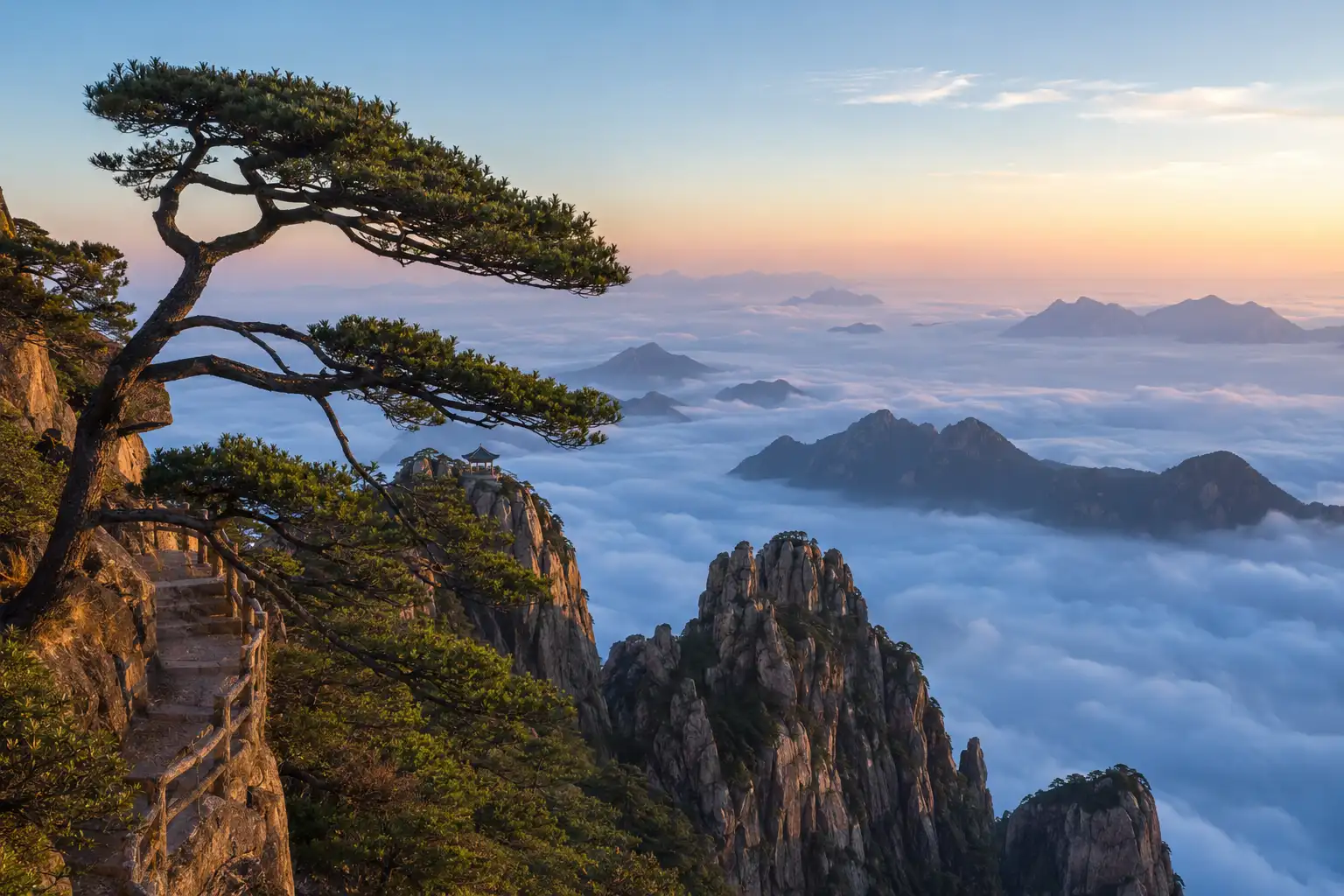
Huangshan is a classic East China nature and heritage route, pairing dramatic mountain views with nearby villages like Hongcun and Xidi.
Suggested stay
2-4 days
Travel style
Mountains
Best for
Mountain scenery, villages, photography
Content confidence
Reviewed for practical travel use
Huangshan city overview, suggested stay, highlights, transport notes, nearby trips, and connected planning guides have been reviewed for practical trip planning.
Use this city page as a planning framework. Confirm current opening hours, ticket windows, transport schedules, and local rules before booking.
Check official sources before booking time-sensitive items.
Planning overview
How to Plan Huangshan
Huangshan works best as a combined mountain-and-heritage trip rather than a single-city break. Most travelers come for the granite peaks, pine trees, and cloud-sea views, then use Tunxi or Tangkou as their base before adding one or two Huizhou villages. Plan around weather more than around a fixed checklist: if visibility is poor, shift to Tunxi or a village day and keep the mountain for the clearest forecast you can get.
Yellow MountainHongcun VillageTunxi Old Street
Best suited for
Mountain scenery and photography
Sunrise and cloud-sea planning
Huizhou villages and architecture
East China rail itineraries
Best time to visit
Spring and autumn are the most reliable seasons for a Huangshan trip, with cooler temperatures and better walking conditions. April to June is wetter but can produce the mountain's famous cloud sea after rain, while summer is humid below but still busy because the summit stays cooler. Winter can be beautiful in snow and rime, but some paths become icy and periodic closures are normal.
Stay in Tangkou or on the mountain if sunrise and cloud-sea views matter; stay in Tunxi if you are arriving late by train or plane.
Keep your mountain day flexible, because Huangshan is often clouded over and the best views depend heavily on weather.
Use the shuttle buses and cable cars to control hiking time; a full walk up and down is a serious mountain day, not a casual stroll.
Book mountain hotels early for weekends and holidays, and carry an extra layer even when the lowlands feel warm.
The mountain scenery is the main reason to come, and it sets the pace for the whole trip.
Suggested routes
Itineraries for Huangshan
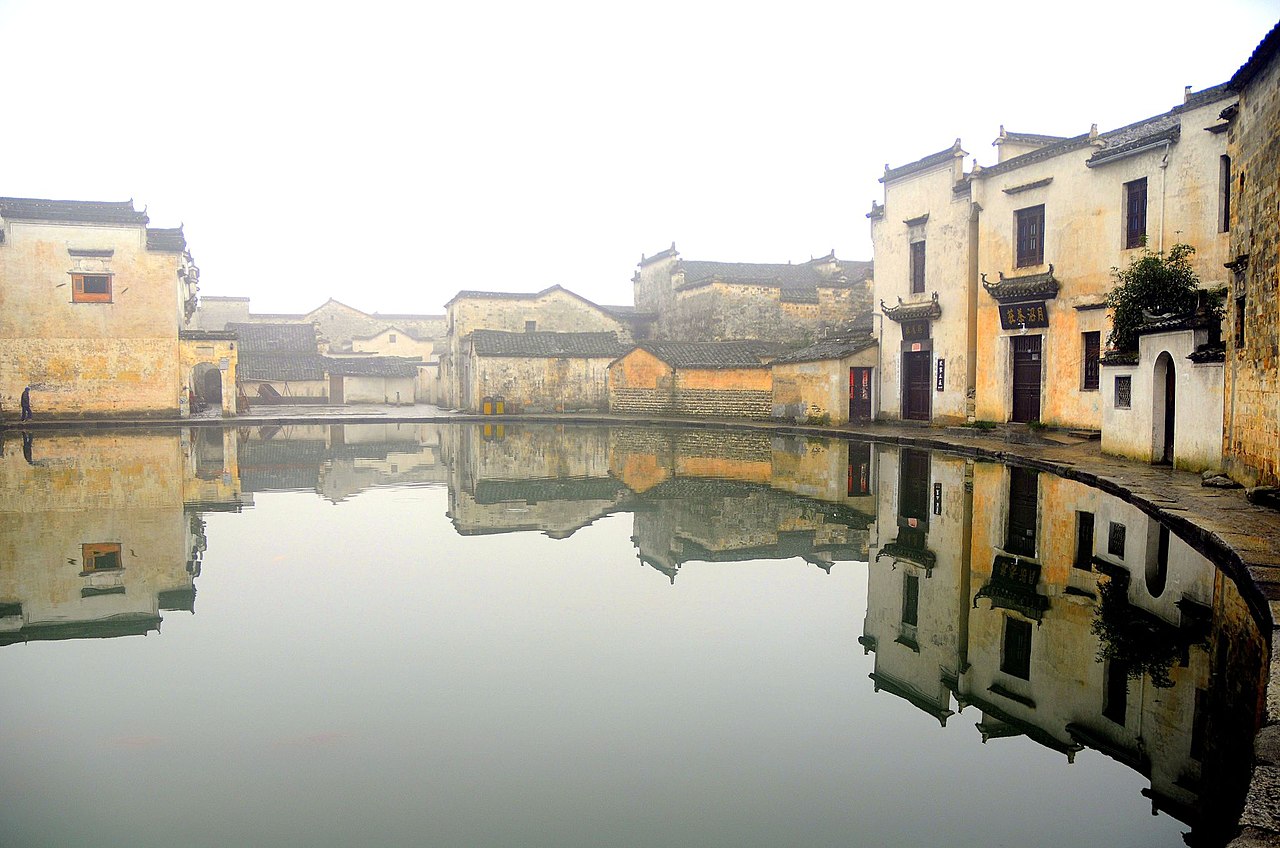
Hongcun shows why many Huangshan trips work best when the mountain is paired with a Huizhou village day.
Wikimedia Commons
1 day
Single-day mountain focus
Best if you are already in Tangkou and the forecast is clear. Use lifts and shuttle buses to keep the day about viewpoints rather than endurance.
1Start from Tangkou and take the shuttle to a south-side cable car
2Walk the summit ridge around Beihai or Bright Summit depending on visibility and energy
3Include Yuping and the Greeting Pine if routes are open and conditions are stable
4Descend by cable car and sleep in Tangkou or Tunxi
2 days
Classic Huangshan overnight
This is the strongest first trip because it gives you two light windows on the mountain and reduces the pressure to do everything in one push.
1Day 1: Arrive in Tangkou or Tunxi, ascend by cable car, walk a manageable ridge section, and stay on the mountain for sunset
2Day 2: Catch sunrise, walk another major section such as Beihai to Yuping or the Xihai side, then descend in the afternoon
3Use Tunxi Old Street for your final evening if you want a calmer finish than Tangkou
3-4 days
Mountain plus Huizhou villages
The extra time lets you avoid forcing the mountain in poor weather and gives room for the region's old villages and town texture.
1Day 1: Arrive in Tunxi, walk the old street, and check the next day's mountain forecast
2Day 2: Move to Tangkou and ascend Huangshan, keeping the afternoon for the summit ridge
3Day 3: Sunrise and final mountain walks, then descend and continue to Tunxi or Yi County
4Day 4: Visit Hongcun or Xidi, or use the extra day as weather insurance for the mountain
Neighborhoods
Best Areas to Explore
Tangkou and the south gate base
Tangkou is the practical staging point at the foot of Huangshan, built around the tourist distribution center, shuttle buses, hotels, and easy access to the main southern cable cars. It is not the prettiest stop in the region, but it is the right place when you want an early start, a late descent, or simple mountain logistics.
Tourist distribution centerSouth gate shuttle busesYungu and Yuping cable car access
Beihai and the summit ridge
This is the core overnight zone on the mountain, where many visitors sleep for sunrise, sunset, and the chance of a cloud sea the next morning. It is the best area if you want to link major ridge walks without spending all your energy on a same-day ascent and descent.
Beihai Scenic AreaBright SummitSunrise viewpoints
Yuping and the Front Mountain
The Front Mountain side is the classic first look for many visitors, especially around Yuping and the Greeting Pine. When key peaks are open, this is also where routes branch toward Lotus Peak and Celestial Capital, making it one of the most dramatic parts of the park.
Greeting PineYuping Cable CarLotus Peak and Celestial Capital routes
Tunxi Old Street and the city base
Tunxi is the most useful urban base for arrivals, departures, food, tea shopping, and a lower-pressure evening before or after the mountain. It adds Huizhou architecture and a real city stop to a trip that would otherwise be all transport nodes and scenic area hotels.
Tunxi Old StreetXin'an River walksTea and local snack shops
What to see
Top Sights
Huangshan summit trails
The main reason to come: granite peaks, sheer drops, pine trees shaped by wind, and a network of paved mountain walks that make a high dramatic landscape accessible to ordinary travelers. The best experience comes from linking viewpoints rather than treating the mountain as a single photo stop.
If visibility is poor, shorten the day and wait for a better weather window instead of forcing every major viewpoint.
Greeting Pine and Yuping Scenic Area
The Greeting Pine is Huangshan's best-known single landmark, perched beside one of the mountain's most photographed approach areas. Yuping is also important because it ties together the classic Front Mountain scenery and routes toward major peaks when they are open.
This area gets crowded in good weather, so go earlier or later in the day if you want calmer photos.
Xihai Grand Canyon
This is one of the mountain's most dramatic walking sections, with steep scenery and a more immersive sense of depth than the easier ridge viewpoints. It is where Huangshan feels least like a postcard overlook and most like a full mountain route.
Do this only if weather, trail conditions, and your energy level all line up, because it adds real time and effort to the day.
Lotus Peak and Celestial Capital Peak
These are two of Huangshan's most famous peak routes, valued for the higher, more exposed mountain experience beyond the standard scenic loop. Because of periodic closures and alternating opening schedules, they feel like bonus rewards rather than guaranteed checklist items.
Check current opening status before building the whole itinerary around either peak.
Tunxi Old Street
Tunxi Old Street is the easiest urban heritage stop in the region, with Huizhou-style buildings, tea shops, and straightforward evening wandering. It is especially useful on arrival day, after a late descent, or whenever the mountain forecast is poor.
Treat it as a flexible half-day or evening block rather than a full sightseeing day unless you are pairing it with museums or riverfront walking.
Getting around
Transport Notes
Arriving by air
Huangshan Tunxi International Airport is the nearest airport, in the Tunxi area of Huangshan City. It is about an hour by road from the mountain base at Tangkou, so it works best if you are connecting directly into the region rather than expecting a big urban arrival experience.
Arriving by train
Huangshan North Railway Station is the main high-speed rail gateway, with services to cities such as Beijing, Shanghai, Guangzhou, Fuzhou, Nanchang, and Qingdao. Huangshan Station in Tunxi still matters for slower and overnight services, including the classic overnight route from Shanghai that takes about 11 hours.
Getting around
From the airport, stations, or long-distance bus stops, most travelers continue by bus to Tangkou, usually taking about an hour. From Tangkou, scenic-area shuttle buses connect to the main south-side trailheads and cable cars, and private cars or taxis cannot simply drive straight to every entrance point inside the protected area.
Taxis and ride-hailing
Taxis are useful for airport, station, and hotel transfers, especially between Tunxi and Tangkou, but they are less useful inside the scenic transport system itself. Keep hotel names and destinations in Chinese, and do not assume a taxi can replace the required park shuttle segment.
Food
What to Eat
Start with Huizhou flavors
Look for Huizhou dishes rather than generic tourist-set meals. Good anchors include stinky mandarin fish (chou gui yu), hairy tofu (mao doufu), bamboo shoots, and mountain ingredients such as stone-ear mushrooms. The flavors often lean savory, braised, and slightly rustic rather than light or delicate.
Eat where the logistics make sense
Tunxi gives you the most comfortable range of restaurants, tea shops, and snack stops, while Tangkou is better for straightforward meals before or after hiking. On the mountain, food is convenient but notably more expensive, so it helps to carry basic snacks and not rely on summit restaurants for every meal.
Tea is part of the region
This is a strong tea region, so breaks often make more sense in tea shops than in generic cafe chains. Huangshan Maofeng green tea is the obvious local name to look for, and Qimen black tea is another well-known Anhui option if you want something deeper and more malty.
Go next
Easy Trips from Huangshan
Hongcun
Hongcun is the best-known village extension near Huangshan, valued for its preserved Huizhou houses, ponds, and historic water system; buses run from Huangshan Bus Station and Tangkou.
Xidi
Xidi pairs well with Hongcun but feels more about lanes, courtyards, and preserved village planning, so it works well if you want a second heritage stop beyond the mountain.
She County and the old Huizhou area
She County is a good deeper heritage extension if you want more Huizhou architecture, ancestral-hall culture, and a less summit-driven day after Huangshan itself.
Keep planning
Useful next pages for Huangshan
Connect this city page with the practical setup decisions most likely to affect arrival, tickets, transport, and daily movement.